First-ever Clinical Study of Epigenetic Restoration: Administration of ER-100 Was Well-tolerated through Day 56 in Three Participants with Glaucoma, Supporting Dose Escalation in the Ongoing Trial
Interim data from Life Bio’s Phase 1/2A clinical trial of its therapeutic candidate, ER-100, in three participants with open angle glaucoma (OAG) demonstrated that a single intravitreal administration along with daily oral doxycycline was well-tolerated through Day 56 in all three participants and showed preliminary signals of improvement in visual field testing in two participants.
Safety and Tolerability Observations
- A single intravitreal administration of Dose Level 1 ER-100 (2 x 10¹¹ vg) along with daily oral doxycycline to induce OSK expression was well-tolerated in 3 participants with open angle glaucoma (OAG) through Day 56
- There were no reported dose-limiting toxicities, adverse events of special interest, or serious adverse events
- All reported adverse events were related to procedure, steroid, or pre-existing conditions and were not directly associated with ER-100
- Data Safety Monitoring Board recommendation was to escalate to Dose Level 2 (6 x 10¹¹ vg) in OAG participants, with the trial currently ongoing
Visual Field Observations
- Improvements in Humphrey Visual Fields measurements, a standard eye exam that measures a participant’s ability to detect light across many points in their field of vision, scored in decibels (dB), were observed in 2 of 3 OAG participants at Day 56
- In each of these 2 participants, ≥ 28% of points in the visual fields showed a > 4 dB improvement
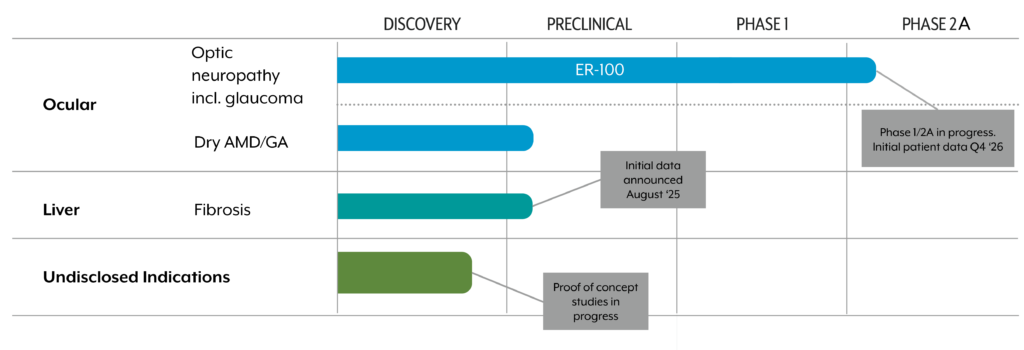
This first-in-human, Phase 1/2A, open-label clinical trial (NCT07290244) is evaluating the safety and tolerability of ER-100 in adults with optic neuropathies. ER-100 uses controlled expression of three transcription factors, OSK (OCT4, SOX2, KLF4), delivered via a single intravitreal injection, with OSK expression induced by systemic doxycycline administered for 8 weeks (56 days). An oral prednisolone taper is administered to minimize risk of inflammation due to AAV-2 immune response. Multiple study visits assessing tolerability and visual endpoints were included in this first 56 day evaluation. For additional information about the clinical trial, see clinicaltrials.gov.
Extensive Preclinical Data on ER-100
Life Biosciences has assembled a comprehensive set of data showing activity of ER-100 in preclinical models of optic neuropathies. Importantly, these data are not just from studies in mice and other rodents, but also in nonhuman primates (NHPs), which show much better likelihood of translation to human results.
Moreover, the data package covers a broad set of findings, all of which support the inference that ER-100 is working by epigenetic restoration to improve visual function.
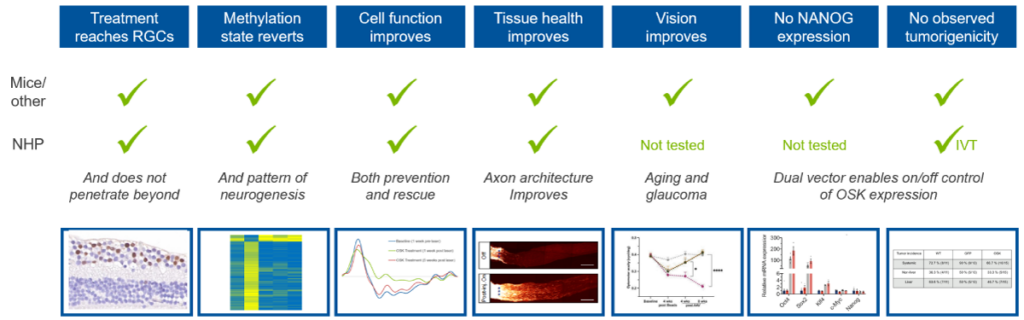
As depicted in the graphic below, we have evidence in rodents and nonhuman primates that:
a) ER-100 enables expression of OSK in retinal ganglion cells (RGCs), which are the cells damaged in optic neuropathies
b) the epigenetic profile as measured by the DNA methylation state of genes changes with damage, but is restored with ER-100 treatment
c) ER-100 improves:
- visual function at the cellular level as measured by pattern electroretinogram (pERG)
- tissue health as measured by axon architecture
- vision as measured by optomotor response (OMR) (not tested in NHPs)
Investigational new drug (IND)-enabling studies for biodistribution and toxicology were successfully completed and supported the advancement of ER-100 into human clinical trials.
Additional Indications
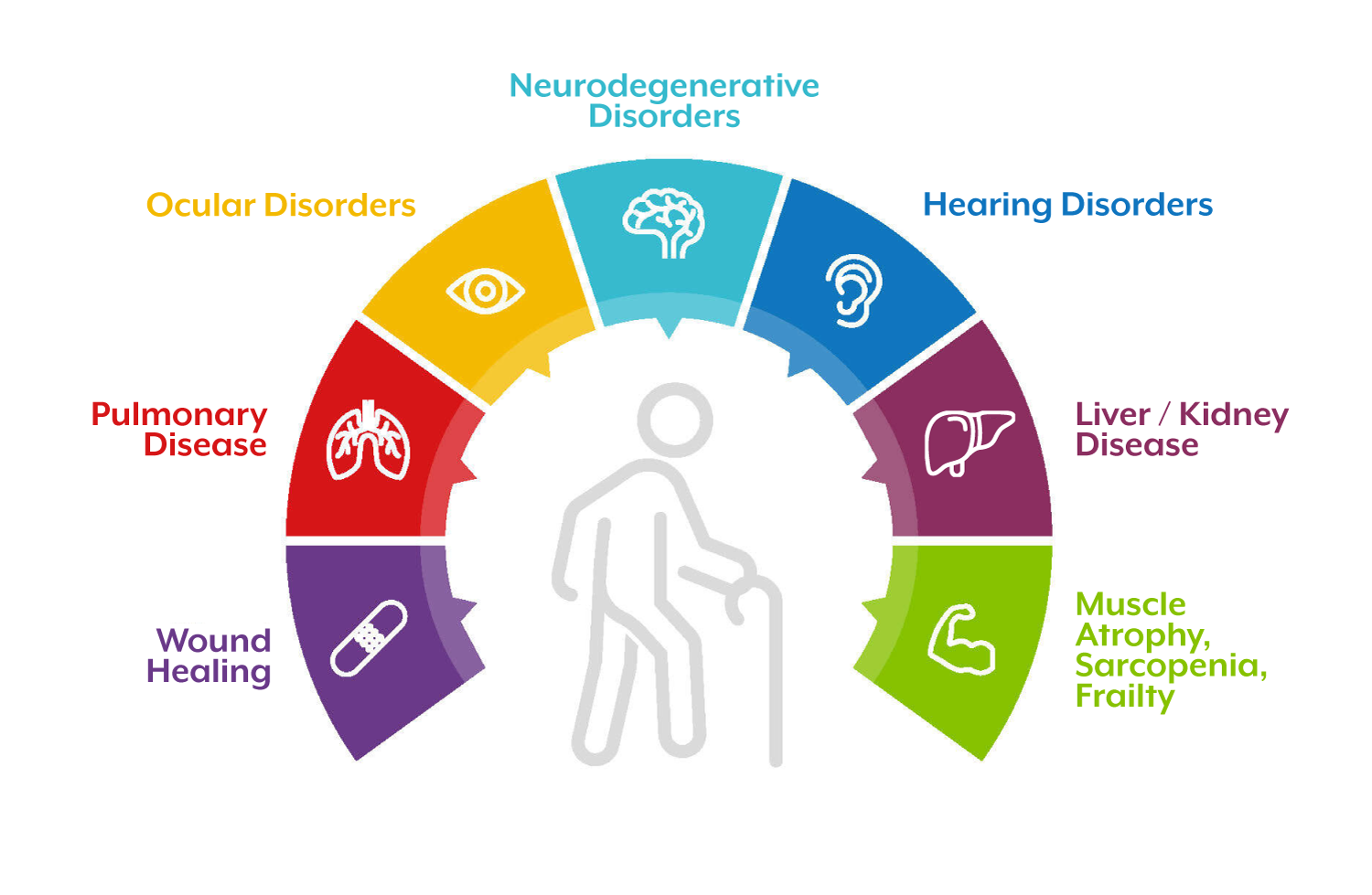
In addition to our lead program, we are exploring the potential of our epigenetic restoration platform in additional age-related indications.
We are developing appropriate delivery systems to enable OSK expression for these organ systems, demonstrating proof of concept in appropriate preclinical models, and identifying/advancing lead candidates.
Preclinical Proof-of-Concept (POC) in Metabolic Liver Disease
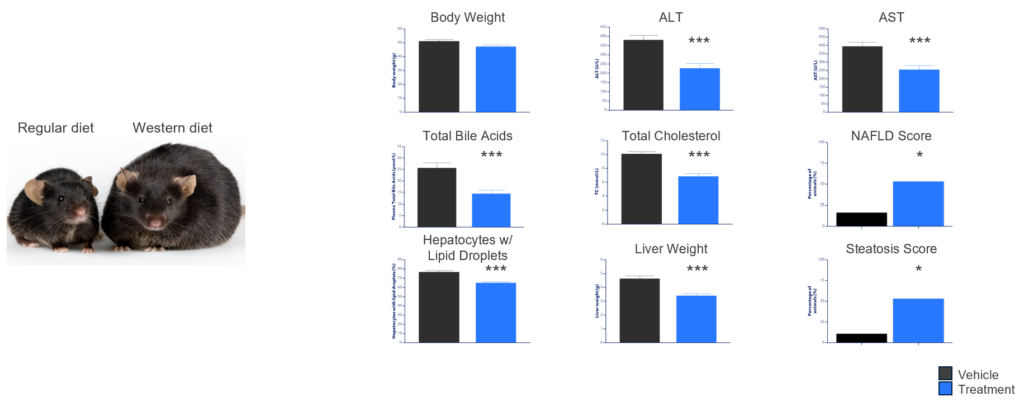
We have released data from preclinical studies of metabolic dysfunction-associated steatohepatitis (MASH) in a mouse model of diet-induced obesity (the Gubra GAN DIO-MASH model). MASH is a progressive, fibrotic liver disease and one of the most prevalent severe age-related diseases, with 10 million patients in the US alone.1
We achieved significant improvement in standard metabolic and clinically-derived biomarkers and histopathology in this preclinical model, evidence not only of therapeutic potential of epigenetic restoration in MASH, but also of the broad applicability of our platform.
MASH is a very different disease from OAG: while the eye is highly compartmentalized and neurons are post-mitotic, the liver has tremendous cross-talk with other organs and hepatocytes are some of the most rapidly dividing cells in the body. The fact that epigenetic restoration works preclinically in profoundly different organs and diseases is evidence of its potential as a broad platform.
Preclinical Proof-of-Concept (POC) in dry Age-related Macular Degeneration (dAMD)/Geographic Atrophy (GA)
AMD is a progressive neurodegenerative disease affecting the retinal pigment epithelium (RPE) and photoreceptors, leading to central vision loss. Dry AMD (non-exudative) is the most common form, accounting for ~90% of cases.
- 8-10% of individuals over 55 years have some form of AMD. Over 25% of individuals older than 80 are affected
Biggest risk factor: aging (common in individuals over 50) - Altered methylation patterns in genes related to inflammation, oxidative stress, and lipid metabolism contribute to AMD progression
- There is no cure for dry AMD, but dietary supplements may slow progression
We evaluated the effects of ER-300m in a mouse model of dry AMD/GA where RPE cells are damaged by the administration of sodium iodate. Expanding on the therapeutic utility of OSK using ER-100 in glaucoma, ER-300m expresses OSK in RPE cells and dose-dependently reduces the sodium iodate-induced damage to RPE cells, indicating potential efficacy in dAMD/GA.
Overall Pipeline